


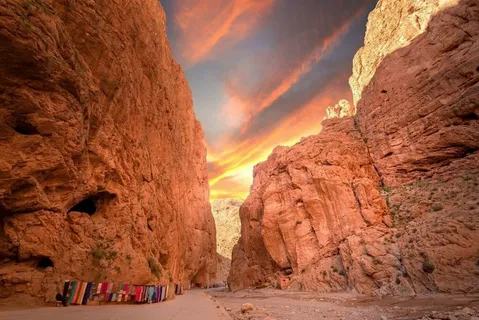
The journey from Day 2 Dades Valley to Merzouga (Erg Chebbi) is one of Morocco’s most dramatic and visually arresting travel experiences. It is a day defined by geological grandeur, shifting landscapes, and cultural depth. From the fertile valleys and winding mountain roads of Dades to the golden dunes of Erg Chebbi near Merzouga, this stretch of southeastern Morocco encapsulates the country’s extraordinary natural diversity. The highlight of the day is undoubtedly the opportunity to walk through the towering limestone cliffs of Todra Gorges, where sheer canyon walls rise majestically on either side, creating an awe-inspiring corridor carved by time itself.
This is more than a transfer from one destination to another. It is an immersive overland expedition through ancient rock formations, traditional Berber settlements, expansive desert plains, and finally into the heart of the Sahara.
Leaving the Dades Valley: A Landscape of Contrast
The day begins in the scenic Dades Valley, often referred to as the “Valley of a Thousand Kasbahs.” Located between the Atlas Mountains and the Sahara, this region is characterized by lush palm groves, earthen kasbahs, and the serpentine roads that wind through dramatic red-rock gorges. Morning light illuminates the rugged terrain, casting warm tones across the valley’s layered rock formations.
As you depart the valley, the road traces the contours of the High Atlas foothills. The topography gradually shifts—green fields give way to rocky plateaus and barren stretches. The air becomes drier, and the landscape increasingly reflects the proximity of the Sahara Desert.
Travelers often pause at panoramic viewpoints along the route. From these elevations, the interplay between cultivated valley floors and arid mountain slopes becomes evident. Traditional mud-brick villages cling to the hillsides, blending seamlessly with their natural surroundings.
Walk Through the Towering Limestone Cliffs of Todra Gorges
A defining moment of Day 2 Dades Valley to Merzouga (Erg Chebbi) is the visit to the spectacular Todra Gorges near Tinghir. Here, the Todra River has carved a dramatic canyon through massive limestone formations over thousands of years.
To walk through the towering limestone cliffs of Todra Gorges is to step into a natural cathedral. The canyon walls rise as high as 300 meters (almost 1,000 feet) in certain sections, narrowing to just 10 meters wide at their most constricted point. Sunlight filters down from above, illuminating the pale limestone with shifting hues that range from soft gold to deep amber.
The soundscape enhances the experience. Water trickles gently along the base of the canyon, while climbers scale the vertical walls above. Todra is internationally recognized as a premier rock-climbing destination, attracting enthusiasts drawn to its sheer faces and reliable limestone texture.
Walking through the gorge is accessible and leisurely. The path follows the shallow riverbed, allowing visitors to observe intricate rock stratifications and erosional patterns up close. The scale is humbling. Human presence feels small against these monumental formations.
Local vendors occasionally line the entrance to the gorge, offering traditional handicrafts and refreshments. Despite its growing popularity, Todra retains a sense of serenity—particularly in the early morning hours when tour groups have yet to arrive.
Tinghir: An Oasis Between Mountains
After exploring Todra Gorges, the route continues through the Tinghir oasis, where rows of palm trees flourish alongside irrigation channels. Tinghir serves as a transitional zone between the Atlas Mountains and the pre-Saharan desert.
The oasis environment reflects centuries-old agricultural practices. Date palms, olive trees, and small cultivated plots rely on underground water systems known as khettaras. The contrast between the verdant palm groves and the stark canyon walls underscores Morocco’s environmental diversity within a relatively short geographic span.
This stop provides cultural context. Berber communities continue to inhabit the region, maintaining traditional lifestyles shaped by the rhythms of oasis agriculture and mountain trade routes.
Crossing the Arid Plains Toward Merzouga
As the journey progresses eastward, vegetation thins and the terrain becomes increasingly stark. Rocky plains stretch toward the horizon, punctuated by small settlements and occasional desert shrubs. This portion of Day 2 Dades Valley to Merzouga (Erg Chebbi) reveals the vast transitional landscapes that precede the Sahara.
Many itineraries include a stop in Rissani, a historic trading town that once served as a caravan hub connecting sub-Saharan Africa to northern Morocco. Its traditional market offers insight into desert commerce and regional culture.
Gradually, the first glimpses of sand appear in the distance. What begins as a faint golden line soon transforms into towering dunes rising from the flat expanse. The Erg Chebbi dunes signal arrival at Merzouga—gateway to Morocco’s Saharan interior.
Arrival in Merzouga and the Erg Chebbi Dunes
The Erg Chebbi dunes near Merzouga represent one of Morocco’s most iconic desert landscapes. Unlike the rocky desert (hamada) encountered earlier in the day, Erg Chebbi is an erg—a vast sea of wind-shaped sand dunes that can rise up to 150 meters high.
The arrival experience is transformative. After hours of traversing rugged terrain, the soft contours of the dunes offer a striking visual and tactile contrast. Golden sands shift with the wind, forming ripples and ridges that catch the changing light.
Many travelers conclude Day 2 Dades Valley to Merzouga (Erg Chebbi) with a camel trek into the dunes. As the sun descends, shadows lengthen across the sand, and the sky transitions from bright blue to warm orange and deep indigo. The silence of the Sahara is profound—broken only by the soft footfalls of camels and the whisper of wind over sand.
Overnight desert camps range from traditional nomadic-style tents to luxury accommodations equipped with modern comforts. Evening activities often include local music performed around a campfire, offering cultural immersion beneath a vast canopy of stars.
Geological and Cultural Significance of the Route
The journey from Dades Valley to Merzouga is not merely scenic—it is geologically instructive. The towering limestone cliffs of Todra Gorges reveal sedimentary rock layers formed millions of years ago. Erosional forces, primarily water and wind, sculpted the canyon into its current dramatic form.
The broader region illustrates Morocco’s complex geological history, shaped by tectonic uplift associated with the Atlas Mountains and subsequent erosion across arid plains.
Culturally, this route traces ancient trade pathways. For centuries, caravans transported salt, gold, and textiles across these landscapes. Towns such as Tinghir and Rissani functioned as vital nodes within trans-Saharan commerce networks.
Today, tourism has become an important economic driver, yet the foundational Berber identity of the region remains visible in language, architecture, and agricultural practices.
Why This Day Is Unforgettable
Day 2 Dades Valley to Merzouga (Erg Chebbi) stands out because of its dramatic progression. Few journeys compress such environmental diversity into a single day:
- Fertile valleys framed by red rock formations
- Towering limestone cliffs in Todra Gorges
- Palm-filled oases
- Expansive desert plateaus
- The golden dunes of the Sahara
The opportunity to walk through the towering limestone cliffs of Todra Gorges adds a visceral dimension. Unlike distant scenic overlooks, the gorge places you inside the geological formation. The scale, texture, and acoustics immerse you completely.
By day’s end, standing atop a dune in Erg Chebbi, travelers often reflect on the remarkable transition they have witnessed—from mountain valleys to Saharan expanse in a matter of hours.
Practical Considerations
For optimal experience:
- Start early to avoid midday heat in Todra Gorges.
- Wear comfortable walking shoes suitable for uneven surfaces.
- Carry water, particularly as temperatures increase toward Merzouga.
- Plan arrival at Erg Chebbi before sunset for maximum visual impact.
The road conditions are generally good, though some stretches can be remote. Guided tours are common, but self-drive options are feasible with proper planning.
Conclusion
The journey from Dades Valley to Merzouga encapsulates Morocco’s dramatic contrasts in a single, unforgettable day. From lush valley floors to vertical limestone walls and finally to the rolling dunes of Erg Chebbi, the route unfolds as a layered narrative of geology, culture, and desert beauty.
To walk through the towering limestone cliffs of Todra Gorges is to witness the enduring power of natural forces. To arrive at Merzouga and gaze across the dunes of Erg Chebbi is to experience the vast stillness of the Sahara.
Together, these experiences define Day 2 Dades Valley to Merzouga (Erg Chebbi) as not merely a stage in an itinerary, but as a profound passage through some of Morocco’s most extraordinary landscapes.
