


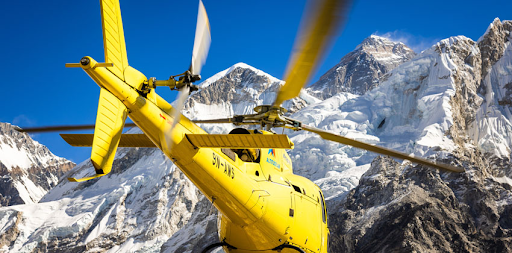
In an era where adventure travel continues to evolve, the Everest Base Camp Helicopter Tour has emerged as one of the most sought-after experiences for those yearning to witness the planet’s highest peak without committing to weeks of arduous trekking. This revolutionary way of exploring the Himalayas has democratized access to one of the world’s most remote and awe-inspiring destinations, allowing travelers from all walks of life to fulfill their dreams of standing in the shadow of Mount Everest.
Redefining Mountain Exploration
The concept of reaching Everest Base Camp by helicopter represents a paradigm shift in how we approach mountain tourism. Traditionally, only those with sufficient time, robust physical conditioning, and the stamina to endure high-altitude trekking could hope to reach this iconic destination. The helicopter tour has transformed this narrative entirely, creating opportunities for business travelers with tight schedules, families seeking shared adventures, and individuals whose physical circumstances might otherwise exclude them from such experiences.
This mode of exploration doesn’t diminish the achievement or the wonder; rather, it amplifies accessibility while maintaining the profound impact of encountering the Himalayas up close. The technology that powers these tours has advanced significantly, with modern helicopters specifically designed for high-altitude operations, ensuring both safety and comfort as passengers ascend to elevations that challenge conventional aviation.
The Flight Experience: A Visual Symphony
From the moment the helicopter lifts off from Kathmandu’s Tribhuvan International Airport, passengers embark on a visual journey that unfolds like a masterfully composed symphony. The initial movements feature the Kathmandu Valley sprawling below, a tapestry of urban development interwoven with ancient temples and rice paddies that have sustained populations for millennia.
As the flight progresses eastward, the landscape transitions dramatically. The helicopter crosses over ridgelines where rhododendron forests cling to steep slopes, their vibrant blooms adding splashes of color during spring months. Rivers carved deep into the earth create serpentine patterns visible from above, their glacial waters rushing toward the lowlands with unrelenting force.
The middle passage of this aerial odyssey brings passengers into increasingly remote territory. Small villages appear as clusters of stone houses with blue or red roofs, connected by narrow trails that represent the only links to the outside world. Suspension bridges span gorges hundreds of feet deep, appearing as delicate threads from the helicopter’s elevation. This perspective reveals the remarkable adaptation of human communities to one of Earth’s most challenging environments.
Encountering the Giants
The crescendo of the flight arrives as the great peaks of the Khumbu region come into view. Mount Everest, known to the Sherpa people as Sagarmatha and to Tibetans as Chomolungma, dominates the skyline with an authority that photographs can never fully capture. At 8,849 meters, its summit pierces the jet stream, often trailing a characteristic plume of snow crystals that signals the ferocious winds at extreme altitude.
Surrounding Everest, a pantheon of legendary mountains creates a 360-degree panorama of unprecedented grandeur. Lhotse, the world’s fourth-highest peak, rises with its massive south face—one of mountaineering’s greatest challenges. Nuptse’s dramatic ridgeline creates a natural amphitheater, while Ama Dablam’s distinctive pyramid shape has earned it the nickname “Matterhorn of the Himalayas.” Each peak carries its own history of triumph and tragedy, of human ambition tested against nature’s supreme indifference.
The helicopter’s maneuverability allows for perspectives impossible from ground level. Passengers can observe the Khumbu Icefall, that treacherous maze of crevasses and seracs that represents the first major obstacle for Everest climbers. The Western Cwm stretches beyond, a vast basin of snow and ice flanked by walls of rock and ice that tower thousands of feet overhead. These features, discussed in countless mountaineering accounts, suddenly become tangible realities rather than abstract concepts.
The Landing: Touching the Himalayan Heights
When the helicopter descends toward its landing site—typically at Kala Patthar or sometimes near Everest Base Camp itself—passengers experience a transition from observation to participation. The moment the doors open and mountain air rushes in, carrying the scent of snow and rock, the experience becomes visceral. Temperatures that may have been comfortable inside the heated cabin plummet instantly, reminding visitors that they’ve entered an environment fundamentally hostile to human life.
Those precious minutes on the ground offer opportunities that extend beyond photography, though the images captured here often become treasured possessions. It’s the sensory immersion that creates lasting memories: the crunch of frozen ground underfoot, the way sound travels differently in the thin air, the play of light across glacier ice, and the overwhelming scale of mountains that dwarf human perspective. Some visitors report moments of profound emotion, tears freezing on their cheeks as they confront the magnificence and their own smallness within it.
Breakfast Among the Peaks
Many helicopter tour itineraries include a stop at Everest View Hotel or similar establishments in Syangboche, situated at approximately 3,880 meters. Here, passengers can enjoy refreshments or a meal while gazing at Everest through panoramic windows. This interlude provides a moment to process the experience, to warm up with hot tea or coffee, and to engage with fellow travelers about what they’ve witnessed.
These hotels represent remarkable feats of logistics, with every supply item—from coffee beans to construction materials—transported by helicopter or carried by porters along mountain trails. The hospitality offered in such remote settings speaks to the Sherpa people’s legendary welcoming spirit and their ability to create comfort in the most improbable locations.
Beyond Tourism: Supporting Local Communities
The economic impact of Everest Base Camp Helicopter Tours extends throughout the region. While trekkers contribute significantly to the local economy through their multi-day journeys, helicopter tourists also support businesses, employ pilots and ground staff, and contribute to the maintenance of infrastructure. Many tour operators partner with local communities, ensuring that tourism revenues benefit those who call these mountains home.
Additionally, helicopters serve essential roles beyond tourism, providing emergency medical evacuations for trekkers and climbers, delivering supplies to remote villages, and facilitating communication in areas where roads remain impractical or impossible. The presence of helicopter services has undoubtedly saved lives and improved conditions for permanent residents of the Khumbu region.
Conclusion
The Everest Base Camp Helicopter Tour stands as a testament to human ingenuity and our enduring fascination with the world’s highest places. It represents neither a shortcut nor a lesser experience, but rather an alternative pathway to encounter landscapes that have captivated imaginations for generations. By making the Everest region accessible to those who might otherwise never see it, these tours expand the circle of people who understand why protecting such wilderness matters.
For participants, the tour delivers something profound: a direct encounter with natural forces operating at scales that humble human ambition, combined with evidence of human resilience in the communities that thrive in these mountains. The memories forged during those few hours persist vividly, often inspiring deeper engagement with environmental conservation, mountain culture, or simply a renewed appreciation for our planet’s extraordinary diversity. In transforming an impossible dream into achievable reality, the Everest Base Camp Helicopter Tour has earned its place among the world’s truly exceptional travel experiences.
